


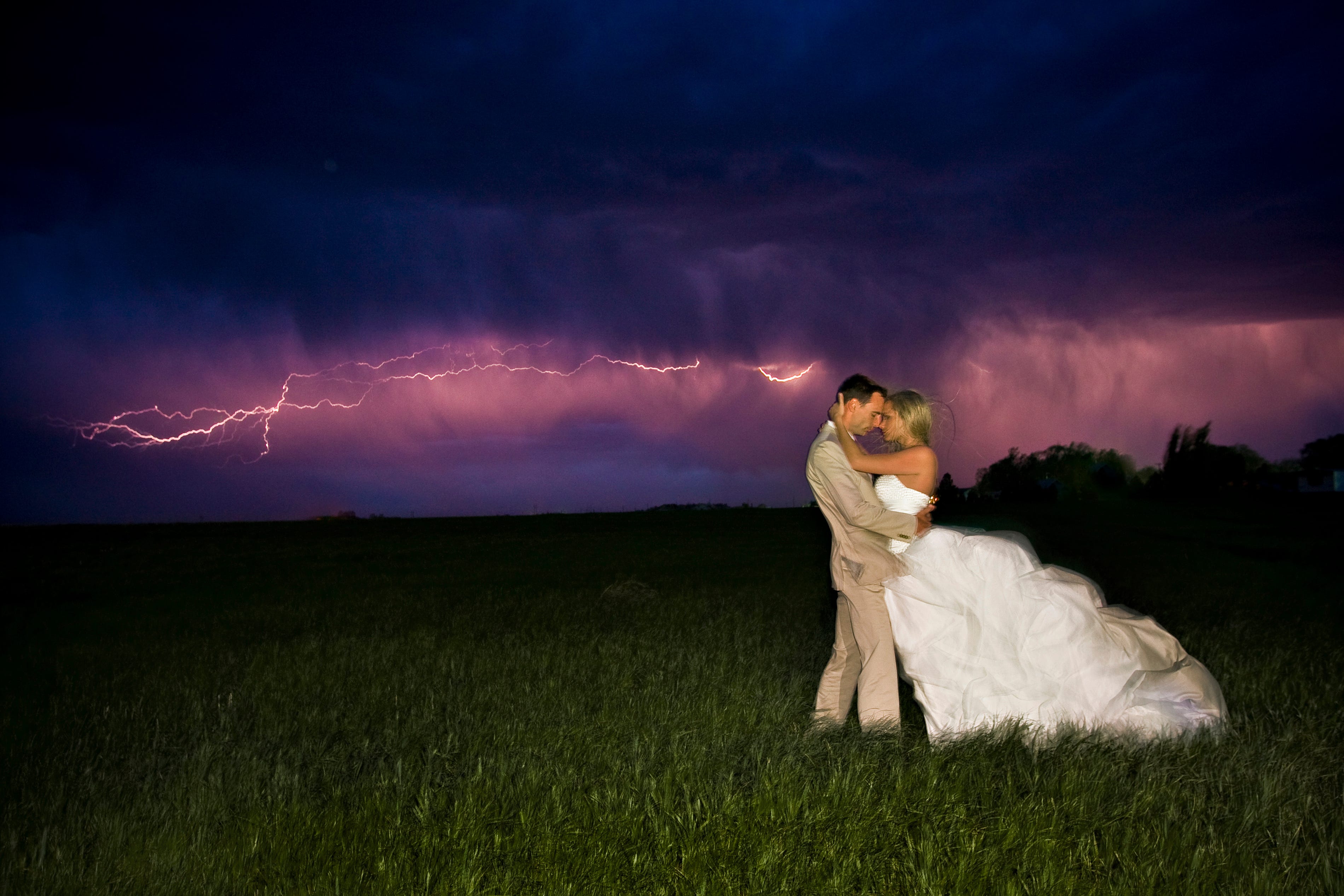
An original photograph. A true story. An invitation to see a little differently.
The photograph I traveled to Tornado Alley to make is not this photograph.
We went looking for a tornado. Mother Nature gave us lightning instead.
It was May 2009 when a photographer friend and we decided it would be a good idea to take a bride and groom into Tornado Alley during tornado season and photograph them in front of a tornado. To be honest, I was very reluctant.
Driving toward a tornado went against most of my natural instincts. Being tornado-adjacent isn’t my idea of blowing off some steam. Tornadoes are unpredictable. Dangerous. And completely indifferent to whether you have a good idea for a photograph.
But eventually, I got talked into it. At the time, I was the photography expert for WeddingChannel.com, which later became part of The Knot. We used the site to hold a contest and find a real couple brave—or perhaps crazy—enough to come along.
The couple would receive an adventure, a collection of photographs and, as part of the arrangement, I would also photograph their actual fall wedding later on that same year.
We found a few sponsors, hired a professional storm chaser and brought along a videographer to document everything. We were given four wedding dresses, which was helpful because we knew at least one of them probably wasn’t coming home clean. Even with the sponsorships, we spent several thousand dollars of our own money to make it happen.
We flew into Denver, rented a vehicle and took off. The goal was simple. Find a tornado. Put a bride and groom in front of it. Make an epic photograph.
Of course, there is nothing simple about chasing weather. For roughly five days, we traveled wherever the forecasts took us. We photographed the couple in Colorado’s sand dunes with mountains rising behind them. We encountered rain, wind, dust, snow and a rainbow.
We stayed in Motel 6s, got up every morning and started chasing again. There is an entire culture built around storm chasing that I knew nothing about. Storm chasers drove vehicles covered with antennas and weather equipment. Tour vans carried people—many of them from other countries—who had traveled to America hoping to see a tornado.
We would arrive in a quiet town at night and wake up to find the parking lot filled with strange vehicles and a small army of people staring at the sky. One of those stops took us to Gurley, Nebraska.
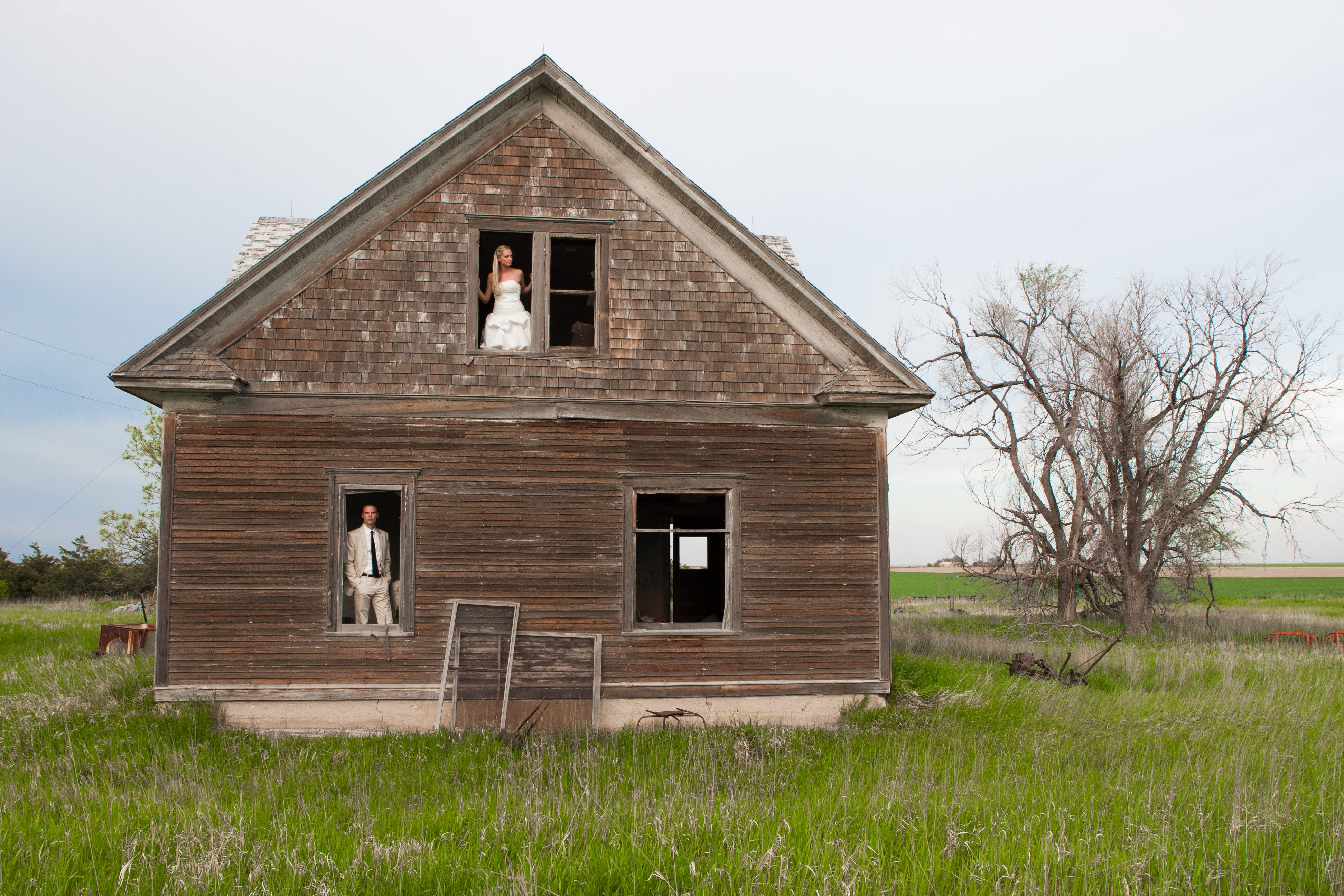
We arrived the day before the weather was expected to develop. With several hours to fill—and photographers not being particularly good at sitting around doing nothing—we went exploring. On the way into town, we had passed an abandoned farmhouse and barn surrounded by open fields. It was too good to ignore.
We put the couple in their wedding clothes and spent the afternoon photographing them around the property. I posed them in the broken windows of the house, inside rooms with walls covered in peeling pink paint and among the young crops growing in the surrounding fields.
As the day went on, we could see a storm beginning to build in the distance. Across the road stood several large grain silos. The sky grew darker. The wind picked up. And we started seeing lightning.
Our storm chaser was not with us. He was back at the hotel, so at that moment we were acting independently. We crossed the road, set up in the field and decided to see what we could capture.
By then, it was dark. I placed my camera on a tripod and set it for a long exposure—somewhere around five, six or seven seconds. Photographing lightning this way requires a little knowledge and a lot of hope. When I pressed the shutter, a flash illuminated the couple and helped freeze them in place. The shutter then remained open, recording the dark sky.
All I could do was hope lightning appeared before it closed. Sometimes it did. Sometimes it didn’t. I knew I had captured lightning in a few frames because I would quickly spot-check the exposures on the back of the camera. But we were working fast, and none of us was particularly interested in standing around studying photographs.
The wind was whipping through the silos beside us, creating an eerie sound that grew louder and louder by the minute. We had traveled all that way hoping to find a tornado. Now every strange sound made us wonder if one was finding us. The couple was scared. So was I.
There I was in an open field, surrounded by lightning, with my hands near a camera mounted on a metal tripod. I tried to touch it as little as possible. Sometimes photographers do things to make an image that seem questionable afterward. This was probably one of those times.
I captured images for perhaps fifteen or twenty minutes. The wind intensified, the rain became heavier and the sound coming through the silos told us it was time to stop.
We had already pushed our luck far enough. It wasn’t until later that I understood exactly what we had captured. The lightning hadn’t simply flashed somewhere in the background. It had traveled almost completely across the sky, creating a brilliant streak of light behind the couple.
The storm had turned the sky purple. The wind lifted the bride’s hair and moved her dress. The flash illuminated the couple and the grass in front of them while the long exposure recorded the lightning behind them. It all happened in a single frame.
People have asked whether I added the lightning in Photoshop. I didn’t. Other than the basic adjustments I make to a RAW file—setting the whites, blacks and color—this is what happened in front of my camera.
No composited sky. No added lightning. Just a little bit of skill, a little bit of luck and a few seconds when everything came together.
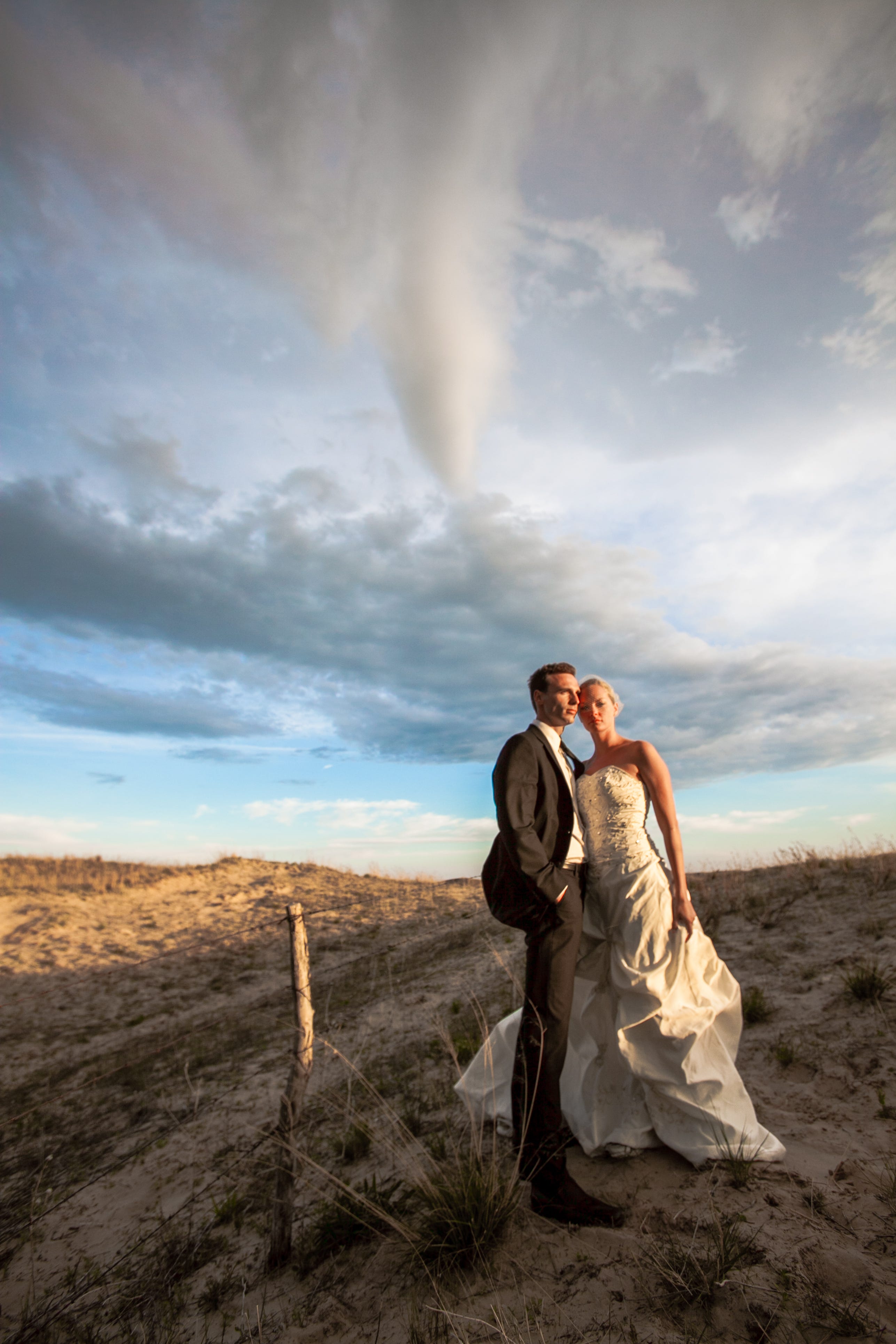
Our adventure continued. On the final day of chasing, we stopped in the Sandhills of Nebraska. Our storm chaser told us it was probably our last opportunity to see a tornado. There didn’t seem to be much happening, so we placed the couple on a hill and began working with the late-day sunlight.
The storm chaser remained near the road, perhaps two hundred yards away. Suddenly, he began pointing toward the sky. “Tornado! Tornado!”
The bride and groom started to run. I told them to stay where they were. Looking back, I’m not sure that was especially comforting. What appeared above them wasn’t the enormous tornado we had imagined when we began the trip. Our storm chaser called it a cold-air funnel as it began reaching down from the clouds.
But it was there. On our final attempt, at our final location, we had come as close as we were going to get. We didn’t get completely skunked. And yet, the funnel photograph wasn’t my favorite image from the trip. The lightning was.
That may be the real lesson of Romancing the Storm.
We began with a very specific intention. We invested our time, our money and maybe a little bit of our common sense into pursuing it. I almost didn’t go because I was afraid.
But I went.
We prepared. We traveled. We kept showing up. We put ourselves in places where something extraordinary might happen—even though we couldn’t control what that something would be.
Photography is often a little bit of luck and a little bit of skill. But before either of those can matter, there has to be intent. Intent gets you out the door. It takes you to the place where luck can find you.
And sometimes, when you pursue an idea with genuine intention, God, the universe — or perhaps both, give you something even better than what you asked for.
We went looking for a tornado. We found this.
When was the last time you had to refocus—not on what you set out to find, but on what you discovered instead?
Every photograph tells more than one story. The one we see, the one behind the image, and the one it awakens within us.