

An original photograph. A true story. An invitation to see a little differently.
Someone was in trouble.
I don’t remember who. I don’t remember exactly what was said. Honestly, I don’t even remember who this woman was. I believe she may have been the bride’s grandmother. But I remember this photograph. I’ve always loved it.
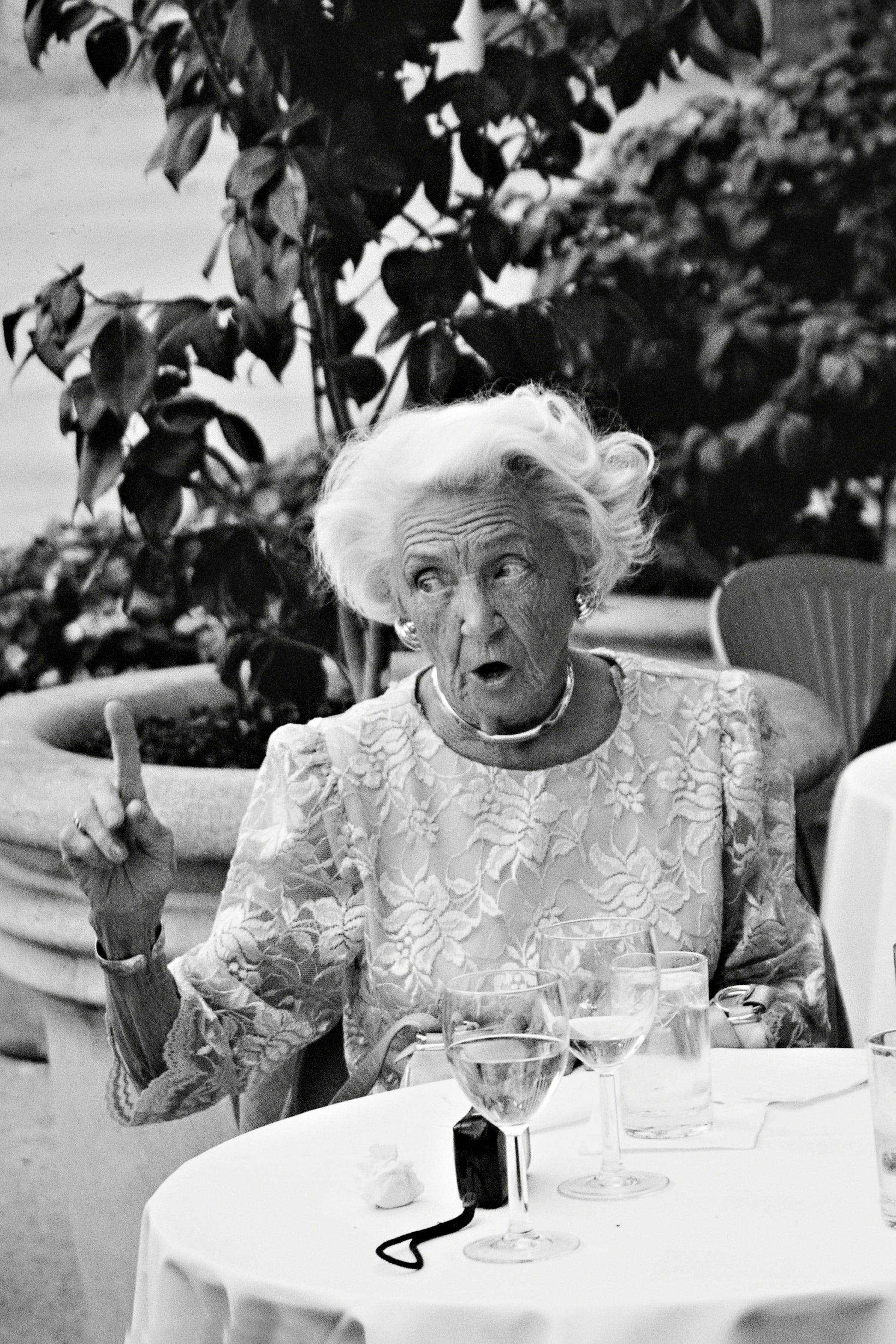
Her mouth is open mid-sentence. Her eyes are locked on someone just outside the frame. And that long, bony finger is raised and shaking in a way that tells you whoever was on the receiving end was getting an earful.
I’ve always thought of her as my grandma. I mean I captured her… so I guess I get to claim her.
Look a little longer and the details make the photograph even better. Her perfectly styled white hair. Her wrinkly face and skin that looks amazing in black and white. The big gold earrings, necklace and bracelet. The flowery lace dress and her purse tucked securely in her lap.
And sitting on the table, behind the wine glass, is something you don’t see much anymore. A point-and-shoot film camera. That little detail dates the photograph, but there’s another camera you can’t see that makes this image important to me. The one in my hands. This photograph was taken at the very first wedding where I brought a 35mm camera with me, circa 1993.
When I started photographing weddings around 1988–89, professional wedding photographers shot medium format. I was using Hasselblad cameras. Bigger negatives. Better image quality. Big expensive German made cameras. And if you showed up to shoot a wedding with a 35mm camera back then, well... you weren’t necessarily considered a professional wedding photographer. At least that’s how it felt back then.
The Hasselblad was also a very different way of working. It was bigger and more cumbersome. Everything was manual. You carried a light meter to read the light, set your exposure and took your photograph. You only had 24-frames on a medium format film back, so you learned to be selective. You didn’t just hold down the shutter and hope something good happened, you had to hand wind the film to get to the next frame and re-cock the shutter.
That’s when I bought my first 35mm camera. By then, 35mm film was getting better. The grain structure was getting tighter, and film quality had improved. The camera was smaller, faster and, compared with my Hasselblad, incredibly freeing. I could put it on Program mode and let the camera worry about some of the technical stuff while I worried about something else.
What was happening in front of me.
Instead of always thinking about the camera and all the settings, I could react. I could observe. I could see a moment developing, raise the camera to my eye and shoot. Which is exactly how I captured this image.
Looking back now, I think my 35mm film camera helped change the way I photographed weddings. It moved me toward the candid, storytelling style of photography that would eventually become such an important part of my career.
And Grandma here was one of my first unsuspecting subjects. She became a bit of a celebrity in my business. I used this photograph in advertising for years with the headline:
“Don’t let your grandmother find out you didn’t use Robert Evans.”
I was completely putting words in her mouth, of course. But look at her. It worked. And maybe that’s one of the reasons I’ve always loved this photograph so much. We have absolutely no idea what she was saying. Was she angry? Was she giving someone unsolicited advice? Was somebody misbehaving? Was she telling a story? Maybe she wasn’t scolding anyone at all. The photograph doesn’t tell us. It leaves something for us to do.
Imagine…
I think that’s one of the things I love most about still photography. A photograph doesn’t move on to the next frame. It doesn’t tell you where to look. It doesn’t explain everything that happened before or show you what happened next. It just sits there. And if you give it a little time, you start to explore.
You notice the wrinkles in her face. The loud jewelry. The purse in her lap. The lace on her dress. The glasses on the table. The old camera behind them. You begin looking beyond the obvious.
Eventually you start wondering about everything outside the frame. Today, so much of what we see is moving. We scroll. We swipe. We watch. Then we move on to the next thing.
That’s why I still love photographs like this one. They ask something different of us. They ask us to stop. To look. To notice. And maybe even to use our imagination.
Because sometimes what makes a photograph interesting isn’t everything it shows us. It’s everything it doesn’t…
When was the last time you slowed down and “Refocused” long enough to let your imagination fill in what wasn’t there?
Every photograph tells more than one story. The one we see, the one behind the image, and the one it awakens within us
RobertEvans.com