


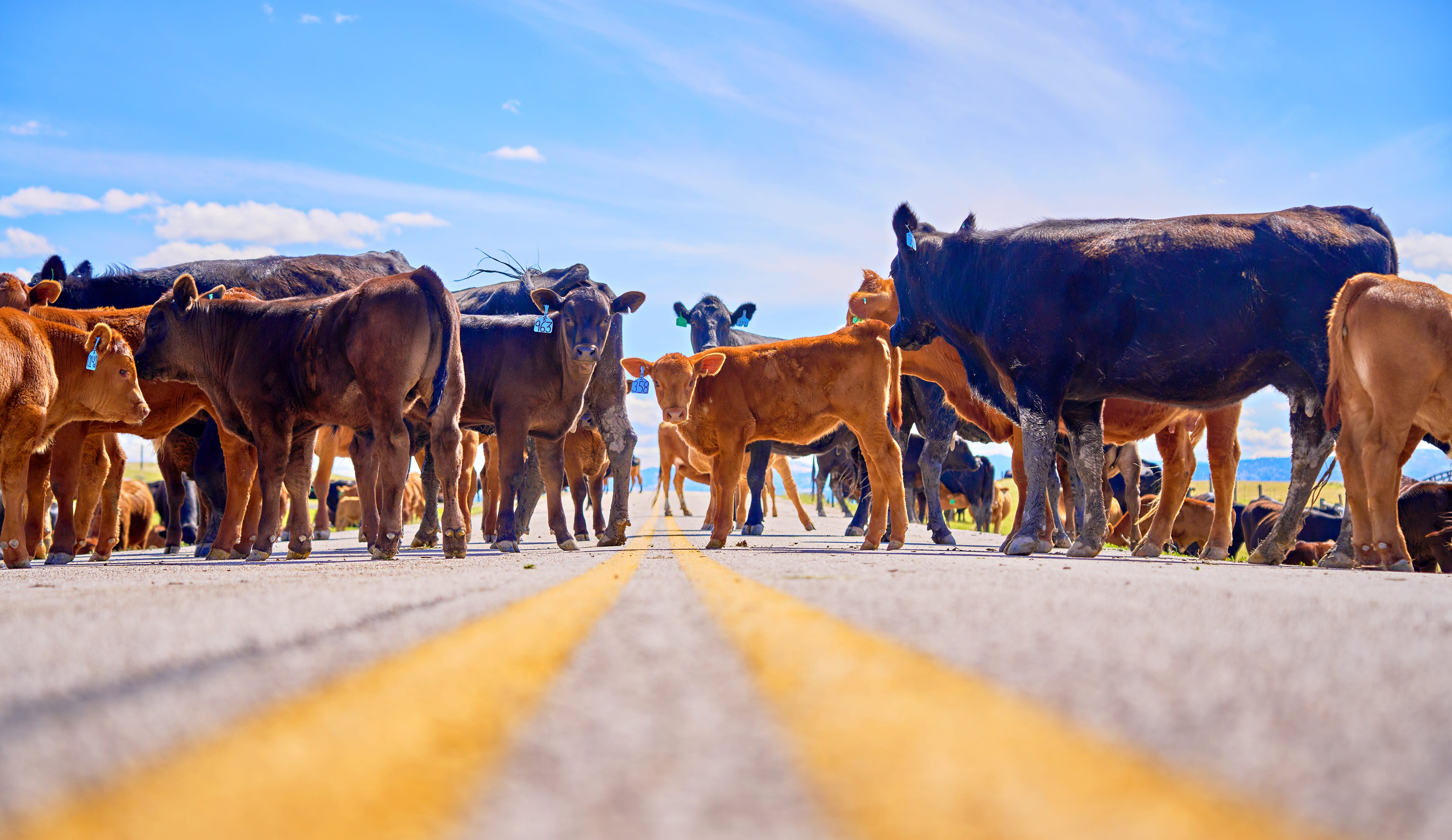
I was lying flat on my stomach in the middle of County Road 91 in Douglas Wyoming.
The asphalt was rough. Hundreds of cows were mooing all around me. Cowboys and cowgirls were working somewhere beyond the frame… trying to keep nearly 400 head of cattle moving in the same direction. And I was doing my best to find one small patch of pavement that didn’t have cow manure on it.
Welcome to a bucket-list experience that wasn’t in my feedbag… a good old fashion, cattle drive!
This image was taken on the first day of a five-day journey I had the opportunity to document over Memorial Day weekend this past May. We would eventually travel roughly seventy miles, climbing from about 5,500 feet to 8,500 feet, moving the cattle from the ranch up into their summer pastures in the mountains.
But before the mountains, before the dirt roads, before the sagebrush, the scenic beauty and wide-open country, the journey began here.
On hot asphalt.
As the janky barb-wire gates on the backside of the ranch were opened, the cattle were pushed out onto a county road running along the ranch. All 400 of them, cows, cafes, and a half-dozen bulls.
There were still cars and huge semi-trucks using the road. Not many, but enough that the whole thing fascinated me. I had never been on a cattle drive before, so watching hundreds of cows simply take over a public road was something completely new.
I photographed the obvious first.
The herd stretching down the road. The cowboys pushing them forward. The sheer number of animals filling the landscape. The traffic having to yield to the cows, pushing forward ever so slowly toward their destination. Those photographs were important. They helped establish what was happening all around me.
But then I focused on the double yellow lines. I thought, What better illustrates the fact that these cows are standing in the middle of a road than a double yellow line? So, I got down on my stomach, flat on the pavement.
I had an idea. I knew what I needed from those yellow lines. I wanted them to come into the photograph from the bottom of the frame and lead your eye directly into the cattle. I focused on the cows and let the road fall out of focus both in front of them and behind them. I took four or five frames. That was it. A few seconds. Sometimes that’s all you need
There are only a couple of cows really looking directly at me. One brown, one black. Another off to the side seems to be giving me a little side-eye, probably wondering what this strange guy was doing lying in the middle of their road. But I especially love the brown calf staring right into my lens, almost as if he knew exactly where I wanted him. Photography, for me, has always been a combination of skill, intention and a little bit of luck.
I got up, looked at the back of the camera and thought: Oh yeah. This is cool. There is something incredibly satisfying about seeing an idea in your head become a photograph almost exactly the way you imagined it. The other thing I love about this image is the shock value. It’s not something you see every day.
But then I had to keep moving. Because this photograph, even though it became one of my favorites from the entire cattle drive, represented only a few seconds of a much larger story. And that may be the part I love most about it. Not every important photograph is the big moment. Sometimes it is simply a detail along the way.
A photograph that helps fill in the story. The double yellow lines tell you something the cattle alone cannot. They tell you where we are. They tell you where this journey begins. What the photograph doesn’t tell you is almost as interesting. You can’t hear the hundreds of cows mooing around me.
And trust me, they moo. A lot. I heard cows mooing in my sleep for weeks afterward.
You can’t hear the cowboys calling out as they try to keep the herd moving. You can’t hear the cattle dogs barking. You can’t smell the cows. You can’t feel the rough asphalt underneath you. And thankfully, you can’t see or smell the cow manure everywhere you look.
I learned very quickly that if you’re going to spend several days on a cattle drive, eventually you’re going to get cow poop on you. I think that’s one of the qualifications for becoming a cowboy. At least that’s how I justified it to myself.
The assignment itself came to me through one of my longtime clients. Her best friend’s family owns this ranch, and the family has been making this cattle drive for three generations. Her father is getting older, and there was a possibility that this might be his last time being part of the drive. My client wanted to give her friend something meaningful. A record of it. So, she asked me if I would go. My answer was simple. Heck yeah.
I had never photographed a cattle drive. I had never spent five days following 400 cattle through Wyoming. And I certainly hadn’t ridden a horse in about forty-five years. The first day I rode. Which, surprisingly, went pretty well. It was definitely possible to photograph from the top of a horse. But I quickly realized something. If I was going to tell this story properly, I needed freedom. I needed to maneuver around the herd. And my horsemanship wasn’t going to lend itself to that freedom and mobility. I needed to get behind the herd. Up a hill. Down a road. Wherever I thought the next photograph might be. So, for the remaining days I rode a quad or four-wheeler.
Every day the landscape changed. The first day was asphalt. Then dirt roads. Then scenic rocky hills with aspen trees, and finally a rural mountain terrain. Eventually we climbed above the tree line into huge open pastures where you could see forever in the distance.
Once the trees ended the final pasture covered with sagebrush and green grass was only a few miles ahead. Thousands and thousands of acres where the cattle and their calves would spend the summer, before eventually making the journey back down to the ranch in fall.
But when I look at this photograph, I don’t think about the destination first. I think about the beginning. I think about being willing to try something you’ve never done before. There are always photographs I would love to make. Places I would love to go. Things I would love to experience. And sometimes we wait for the perfect opportunity.
Sometimes we convince ourselves something is too difficult, too unfamiliar, or too far outside what we normally do. And sometimes a door opens and we walk through it, unsure of what’s on the other side. This assignment was definitely outside what I normally do. But at the end of the day, I tell stories with my camera, and that’s what I am good at and that was my approach.
Mornings started around 4:30 or 5:00. The days were long. The work was physical. The sun was brutal. The butt was sore. There were plenty of moments when I had absolutely no idea what was going to happen next. And I loved it. I had to stay out of the way and not spook the cows, or they might turn and run in the opposite direction. Nobody wants to be that guy… Especially the newbie cowboy not on a horse.
It was challenging. It was exhausting. And it was incredibly rewarding. Maybe that’s one of the reasons this photograph means so much to me. It reminds me that sometimes you have to get down off the horse and lie in the middle of the road. Sometimes you must lie in cow manure. And sometimes, you have to try something simply because you’ve never done it before. And sometimes, if you’re paying attention, the photograph you remember most, isn’t waiting for you at the end of the journey.
It’s somewhere along the way. You just have to see it…
What is something you’ve always wanted to do, but haven’t because it feels just a little outside your comfort zone?
Maybe it’s time to Refocus and see where the road takes you.
Every photograph tells more than one story. The one we see, the one behind the image, and the one it awakens within us.
Here is a link to my gallery with a few more of my favorite images from the cattle-drive
https://robertevansstudios.pic-time.com/art/wyoming-cattle-drive?ptGalleryReady=yes